





























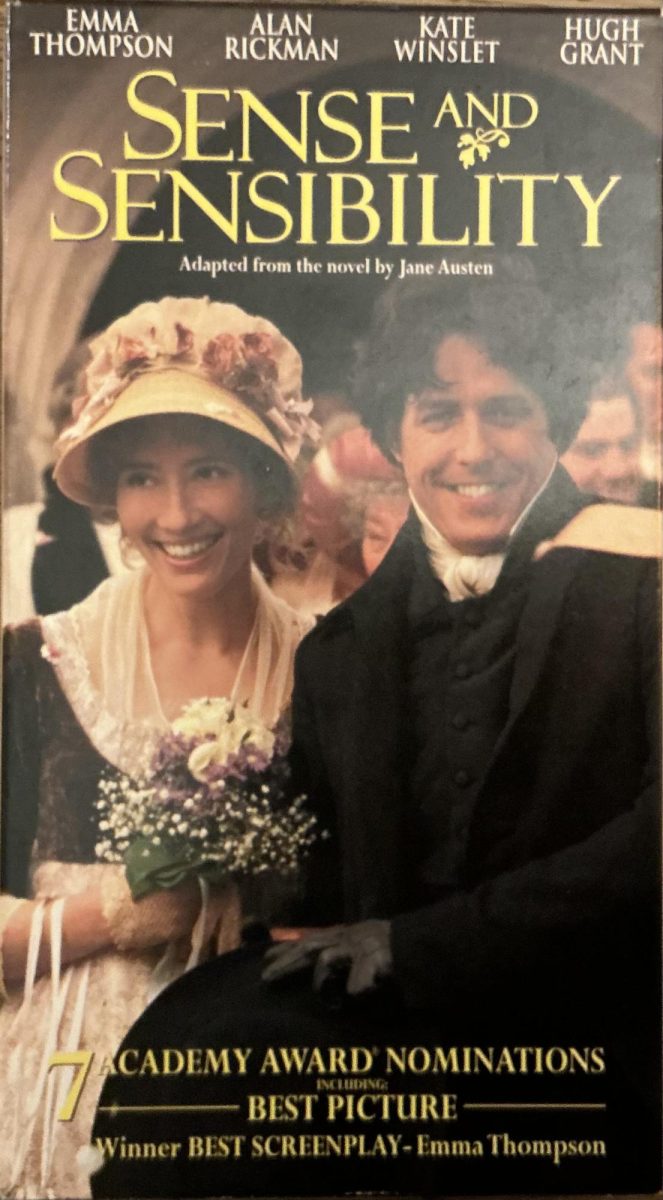
While I resisted as long as I could, the combined force of my mother and grandmother in matriarchal action dissolved the final dregs of my opposition: for years, my mother has been relentless in her desire for me to watch “Sense and Sensibility,” one of her favorite movies of all time. A film adaptation of a Jane Austen novel with the same title, Austen, considered the mother of ‘modern’ romance, cemented tropes in literature still widely used and popular today. Enemies to lovers, second chance romance and unrequited love are a small sample of the most well-known, spanning a variety of her novels and their subsequent film adaptions. However, “Sense and Sensibility” made an especially enduring impact on my mother because it highlighted the benefits of being reserved with your emotions.
“I liked the fact that sense was rewarded,” she comments. “While there is something alluring about sensibility, and it’s reflected in the character of a slew of dramatic heroines, I find it far less interesting than the concept of sense.”
My grandmother was similarly touched by the perseverance of common sense throughout the movie, and while I acknowledge that the prevalence of practicality was undoubtedly one of the film’s more forthcoming themes, my take was slightly different. I found that the movie, while championing the value of sense, also projected an alternative view on sensibility as something to be cherished, like a rare flower in bloom, rather than considered the foolish naïveté of a young girl ignorant to the ways of the world. What the movie does brilliantly is display that the two are not antitheses—they can coexist. And while both sense and sensibility are two very distinctive characters, you can see that as they both grow and change throughout the narrative, each comes to learn a little something about the nature of life from the other.
Elinor and Marianne Dashwood are the movie’s two protagonists, the eldest daughters of a widow; when their father died, he left his estate to their half-brother, his only son and male heir. The movie is surprisingly adept at crafting its female characters, a virtue not to be taken for granted, as the book was published in 1811.
Elinor (sense), while grieving her father’s death, seems to be the only one capable of holding her family together after their loss, and tirelessly searches for vacant properties for them to reside. As her half-brother’s family begins to move into their house, Elinor meets Edward, the brother of her half-brother’s wife (bear with me, I know this gets confusing), and the two form a tentative camaraderie. However, as their relationship grows and begins to blossom, Edward is unexpectedly dispatched by his sister (the wife of Elinor’s half-brother) on a visit to his mother in London, leaving the Dashwoods devastated at the loss of a potential partner for the pragmatic Elinor. Elinor tends to conceal her feelings deep within her heart, unwilling to burden those around her with her sentiments. However, her sister, Marianne (sensibility), sees through Elinor’s façade of indifference.
“I do not attempt to deny that I think very highly of him, that I… greatly esteem him. I like him,” says Elinor, attempting to articulate her feelings to a prodding Marianne. In response, Marianne seethes, “‘Esteem him?’ ‘Like him?’ Use those insipid words again and I shall leave the room this instant.” Both women are full of life and color, contradictions and passion, like us all. Neither one is perfect, yet both are unequivocally human.
Soon after Edward’s departure, the Dashwoods move into Barton Cottage, where Marianne meets two potential suitors: Colonel Brandon and John Willoughby. While Colonel Brandon was smitten with Marianne from the moment he first saw her, Marianne has eyes only for Willoughby. She is openly besotted with the dashing young suitor, who reciprocates in turn. After leading Marianne (and everyone around her) to expect a proposal, Willoughby abruptly disappears under mysterious circumstances, having been cast out by his aunt as a result of scandalous and irresponsible behavior. Subsequently, the Dashwoods learn that Willoughby has become engaged to a wealthy heiress.
During Willoughby’s fleeting courtship of Marianne, Colonel Brandon offhandedly comments to Elinor, “Your sister seems very happy.” Elinor shakes her head and replies, “Yes. Marianne does not approve of hiding her emotions. In fact, her romantic prejudices have the unfortunate tendency to set propriety at naught.”
“She is wholly unspoiled,” Brandon argues. “Rather too unspoiled, in my view.”
Elinor responds, “The sooner she becomes acquainted with the ways of the world the better.”
“I knew a lady very like your sister—the same impulsive sweetness of temper—who was forced into, as you put it, a better acquaintance with the world. The result was only ruination and despair. Do not desire it, Miss Dashwood.”
Colonel Brandon’s solemn rebuttal of Elinor’s apparent exasperation with her sister’s antics is one of the movie’s most important and impactful scenes. While all the other characters have been tempered by societal expectations, Marianne’s untainted innocence and vibrant demeanor are fragile gems that, while beautiful, will not maintain their shine long when faced with the cruel reality of life. After learning of Willoughby’s deception, Marianne’s heart is broken, and she falls into a deep despair. However, as she slowly recovers, she begins to see that Colonel Brandon’s reverence and dedication towards her is unfaltering, despite her rude and indirect dismissal of his feelings.
In contrast to Marianne, Elinor restrains her emotions in the face of an equally fraught love-life. Edward’s past comes to light in unanticipated ways in the form of Miss Lucy Steele, daughter of Mr. Pratt, the principal of the boarding school that Edward formerly attended in Plymouth, deepening the already growing divide between the two. Nevertheless, after a declaration of love that would make your dad’s heart flutter, the two find their way to each other in the end, acquiring a happy ending. The movie crafts two protagonists, neither one perfect, yet both lovable and understandable in their motivations and actions.
Another intriguing facet of the movie is its astoundingly witty prose. A surprisingly brilliant script, the film is unassuming in its hilarity and wit while giving the viewer an abundance of clarity on who the characters are. Filled with subtle, dry humor, at points it seems as though the characters are sharing an inside joke with the audience—one the cast of characters within the film fail to understand.
Elinor and Edward bond over trying to bring the youngest Dashwood, Margaret, out of her shell, and by the end of the first quarter of the movie, Edward has somehow been ‘granted’ the position of Margaret’s servant on her expedition to China. Margaret warns him that he will be very badly treated.
When Marianne first meets Willoughby, she has fallen and sprained her ankle in the middle of a spontaneous downpour when a mysterious, handsome man leaps off his horse, drenched from the rain, and runs down a hill towards Marianne. “Are you hurt?” He asks gravely, crouched over the injured Marianne.
“Only my ankle,” she breathily replies.
“May I have your permission to ascertain if there are any breaks?” His severe tone is amplified by the dramatic angle of his eyebrows (and sideburns). It is the original cliché; the movie is aware of its melodrama and knows when to hit the accelerator and when to pull the break. Interspersed with more solemn moments, the hilarity of moments such as these are highlighted, and got a giggle out of everyone in my family.
Additionally, the movie’s minor characters not only further the plot, but their personalities are distinct and recognizable, giving the movie heart. Mr. Palmer is one of the movie’s driest characters and makes it clear that he is extremely uninterested in everyone’s floundering fancies. His wife, Mrs. Palmer, is the complete opposite. Both offer the Dashwoods unexpected support in their times of need. Lucy Steele seems harmlessly egotistical. In her own bubble, she is ignorant to reality, like an unremarkable Marianne. Sir John Middleton, a cousin of the Dashwood’s and their unofficial landlord, fancies himself a comedian, and is so ‘that one uncle’ coded, one cannot help but identify with the Dashwoods’ plight.
To conclude, “Sense and Sensibility” is a timeless movie. Though the film was released in 1995 and the book written in 1811, the dialogue and plot feel contemporary, enshrining the movie as a true classic. The 30th anniversary of the film is being celebrated by a re-release in December 2025. If you despise romance, I recommend you watch the movie for its timelessness and superb filmmaking technique. If you love romance, I recommend you watch it for the bumbling middle aged men in pantaloons, moral righteousness defined in the slope of their sideburns. And if you love romance but abhor sideburns (like me) I recommend you watch it because your grandmother forced you to.