















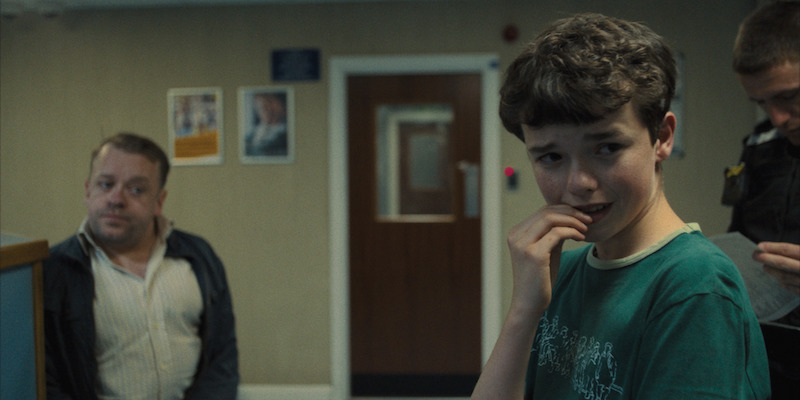
“Adolescence” is mesmerizingly disturbing, and an extremely compelling series. I finished the series in one night, feeling hollow and wrung out as the old antique clock on the wall ticked past midnight. A show unafraid to make its readers uncomfortable is hard to find; “Adolescence” delivered and then some.
The thought-provoking, eye-opening film was comprised of four hour-long episodes that offer a glimpse into the mind of Jamie Edward Miller, played by Owen Cooper, a 13-year-old boy who stabbed a female classmate seven times with a kitchen knife.
Each episode was shot in one continuous take. In “The Making of Adolescence,” Ashley Walters, who played DI Luke Bascombe, said the unusual filming style gave the show the feeling of a theater performance. The immersion was so much more extreme because “once the train starts moving, there’s no stopping it.”
We know who did it. Indisputable evidence that Jamie was the murderer was presented at the end of the first episode. The question the series asks is why? As Jack Thorne, co-creator of “Adolescence,” said, “Adolescence” is “…not a whodunit, but a whydunnit.” At every turn through the most subtle, underlying nuances and details, “Adolescence” forces watchers to wonder why and how a boy like Jamie became a murderer.
The show spans 13 months, dipping in and out of Jamie’s life after his initial detainment. The first episode follows Jamie’s arrest and interrogation. The second covers DI Bascombe as he travels to Jamie’s school, attempting to understand his motives and uncover the murder weapon. The third follows Briony Ariston, played by Erin Doherty, a clinical psychologist conducting a court-ordered psychological assessment on Jamie to assess his understanding of the crime he committed and examine his mental state. Finally, the fourth explores how Jamie’s family deals with the aftermath.
The first episode is a curtain, masterfully concealing the grotesqueries behind. Every detail in the first episode is carefully calculated to make viewers think that Jamie couldn’t have done it, even in the face of damning evidence. We watch the police struggle with how to treat someone who is both a criminal and a child with no concept of the criminal justice system and its workings.
The first episode segues seamlessly into the second, as we the see the school environment which both Jamie and his victim experienced. As DI Bascombe, his teenage son, Adam (Amari Jayden Bacchus) and his partner, Mischa Frank (Faye Marsay) visit the various classrooms, we see DI Bascombe begin to understand just how ignorant he is of the intricate power dynamics that dominate the school, both in the physical space and on social media.
While all the episodes are interesting and insightful, the show’s climax is in episode three, as we watch Jamie and Briony converse. This episode reveals Jamie’s warped view of reality, women and gender roles. His all-encompassing, unsettling need for control and power over women becomes evident.
By episode four, the viewer’s emotional exhaustion is mirrored in Jamie’s family as they navigate life with the stigma and notoriety of having such an infamous son.
“Adolescence” provides a heartfelt portrayal of a problem with no easy answers. Jamie was a 13-year-old boy who came from a loving, present working-class family. He had a few friends. He spent more time on social media than he should have. Jamie felt familiar, like someone you might walk past in the hallway. Watching “Adolescence” has a deeply distressing way of making you identify on a primal level with both the victim and the perpetrator.
Watching “Adolescence” is not for the faint of heart, but it grapples with ugly, raw issues other shows are too afraid to cover.