






















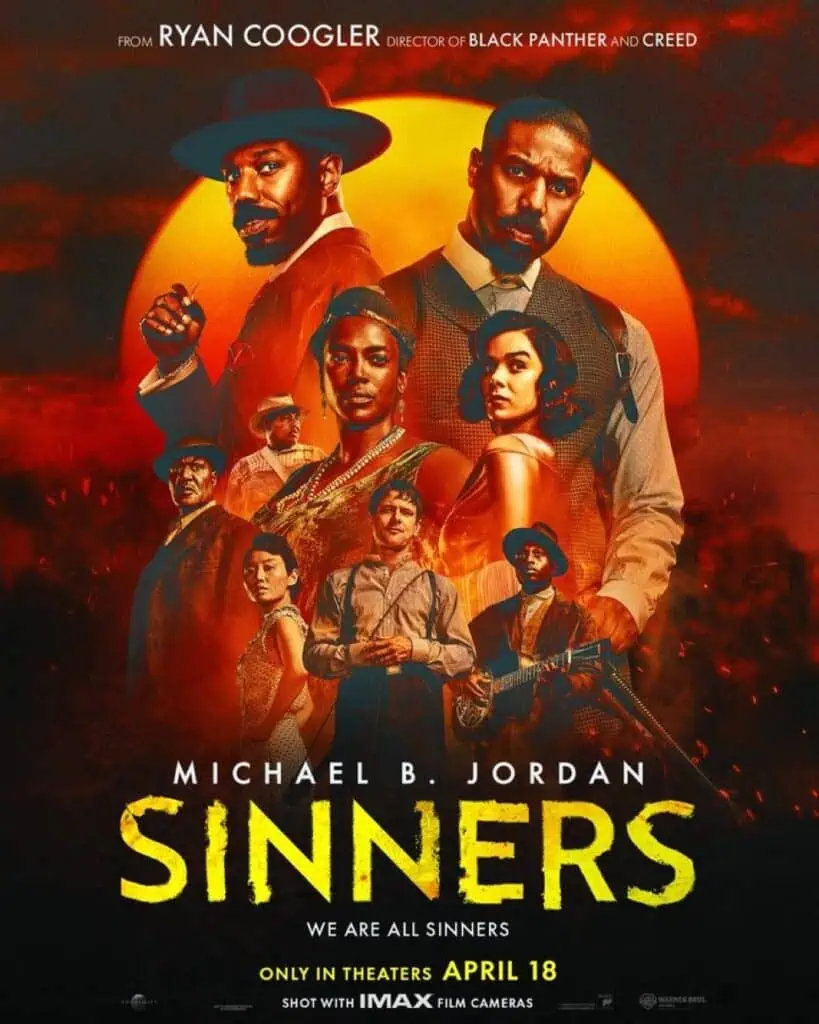
“Sinners” is a movie that you’ve probably heard of.
A record-breaking, critically acclaimed piece of film, “Sinners” presents a creative vision that stands tall in the face of more conventional movies. With an ambitious plot and striking visuals, “Sinners” is undoubtedly one of the most impactful, widely viewed films of 2026.
Written and directed by Ryan Coogler, whom you might know from Black Panther, the film follows twins Smoke and Stack (both played by Michael B. Jordan) as they attempt to open a juke joint, a club-adjacent establishment with food and drink, centered around African American culture. Meanwhile, their younger cousin, Samuel, played by Miles Caton, struggles with his love for the blues in the face of his father’s disapproval.
The appearance of vampires with a hunger for the power of Samuel’s musical talents turn the opening night of Club Juke into a brutal fight for survival.
Michael B. Jordan recently won Best Actor at the Academy Awards. It was well-deserved. When the audience is first introduced to Smoke and Stack, they each wear distinctive hats to help the audience distinguish between them, but as the movie progresses, the hats are removed. The small behaviors that distinguish the two become ever more vital and highlight Jordan’s ability to grasp the nuances and subtle differences between the two characters.
The first half of the film follows Smoke, Stack and Samuel as they prepare for the opening night of Club Juke. Jim Crow has taken a heavy toll on Mississippi’s black population, stripping them of their freedom and autonomy. However, we are also introduced to a community of unshakeable faith and loyalty. The film features a diverse cast of characters, such as Delroy Lindo playing Delta Slim, an aging alcoholic with a love for the blues, and Hailee Steinfeld playing Mary, a mixed-race woman with white skin.
We meet Grace, Bo and Lisa Chow, played by Li Jun Lee, Thomas Pang and Helena Hu, respectively, an Asian family who run a small supermarket complex, and Annie, played by Wunmi Mosaku, a Hoodoo practitioner and Smoke’s estranged wife.
The movie excels in providing us with a window into the profound relationships between these characters. The thoughtful dialogue and evocative cinematic devices used offer a glimpse into the interwoven lives and experiences of a diverse cast of characters.
The second half of the movie paled in comparison to the first. While the vampires were bone chilling, blood and gore dominated the screen, lending the film the feeling of a particularly gruesome episode of Survivor, and, in my opinion, distracting from the movie’s weightier themes.
The villains presented themselves clearly and starkly, and the potential for a more bone chilling, psychological thriller was lost as Smoke and the cast of main characters holed up in the now abandoned warehouse that was host to Club Juke’s opening night just hours earlier.
As Grace processes the grief of losing her husband and the potential of losing her daughter, she invites the vampires inside in a fit of fury, eliminating the one supernatural barrier preventing the vampires from killing all those still alive.
I’m sure you can’t guess what ensued.
If it was slightly more difficult to identify who was a vampire and who was not, and the vampires were not intentionally invited into the warehouse, the film could have branched off in a multitude of intriguing directions, unlocking an even more terrifying narrative. Unfortunately, this plot-line was left unexplored.
The highlight of the movie was undoubtedly the music. With a diverse soundtrack incorporating modern pop, bluegrass and old Irish tunes, the movie was centered around the core, undeniable pull of the blues. The movie’s score takes you on a journey through time, the fluidity and seamless incorporation of a host of different genres truly exemplifying the power of music.
Songs like “Dangerous,” “I Lied to You” and “Pale Pale Moon,” have since been dominating my listening.
The movie must also be considered through a different lens: one that looks past the surface level plot and cinematography and considers the symbolism behind Coogler’s work
The movie centered around the significance of music in a people’s culture, the role religion plays in shaping our identities and the idea that music, for a moment, can allow you to escape all of your troubles and worries, liberating you even when return to a grim reality is inevitable.
One of the movie’s most impactful scenes takes place right before the end, when Samuel is an old man. He has continued to sing and play the guitar, making a career out of his passion for music.
While sitting at an empty bar, Samuel looks up to see that Stack and Mary, now vampires, walk in looking exactly the same as they did that night many, many years ago.
“You know something? Maybe once a week, I wake up paralyzed reliving that night.” Samuel starts softly.
“But before the sun went down, I think that was the best day of my life. Was it like that for you?”
Stack smiles slightly.
“No doubt about it. Last time I seen my brother. Last time I seen the sun. And for just a few hours, we was free.”
Whether or not you enjoy this movie really depends on what you go in expecting. All I knew about “Sinners” prior to watching it was the fact that Michael B. Jordan played the leading role and that it was set during the period of Jim Crow. The vampires were, admittedly, a surprise. However, the movie was unexpectedly insightful, offering indirect commentary on issues still relevant today, and the cinematography was skillful and the score magnificent.