













Ask anyone in New York to describe the New York Mets 2025 season and I guarantee they would call it either disappointing, miserable or a season worthy of the laughingstocks of baseball. It wasn’t supposed to be this way.
Because only 12 months ago, the Mets were in the National League Championship Series against the juggernaut Los Angeles Dodgers, riding good vibes, smiles from the baseball gods and Grimace’s magic touch on an improbable run. Coming off a magical season, expectations were sky-high for the team in Queens this season. But those expectations were crushed after an 83-79 finish, which resulted in missing the playoffs only a season after missing the World Series by just two games.
There are many questions that need to be answered in Queens this winter, from offensive, to defensive, to questions about their prospects and coaching staff. And today, in this two-part article, I’ll dive into what to look for this winter as the Mets strive to contend in 2026.
What Went Wrong in 2025?
At some point in the 2025 season, every aspect of the Mets’ play had a significant issue, and none was more evident than the lack of run prevention. The Mets pitching rotation entered the season as the major weak point of the team, after an offseason that saw Mets President of baseball operations David Stearns sign no frontline starters, and rely on what worked for him in 2024, which was fixing journeyman starters.
Kodai Senga, who pitched all of 10.1 innings in 2024 including the postseason, opened 2025 as the Mets ace, with David Peterson, a lefty who had a stellar end to 2024 as the workhorse of the rotation. Tylor Megill, much to the chagrin of Mets fans, opened as the Mets’ three pitcher, and Clay Holmes and Griffin Canning were the Mets new additions and wildcards on the roster. Sean Manaea, who was given an extension by the Mets last winter, started the season on the injured list, along with Frankie Montas, a journeyman who hadn’t been the same pitcher after a string of injuries derailed his career.
Surprisingly, Stearns’ strategy worked for a few months. Through June 12, the Mets led the MLB with a 2.83 staff ERA, and were second in staff WAR, at 10.9. They were top 10 in xERA, strikeouts per nine (k/9) and finished 13th in innings pitched by starters. Senga had an ERA below two, and Peterson was on his way to his first trip to the MLB All-Star Game. Canning, who previously hadn’t had an ERA below 4.30 with the Los Angeles Angels, had an ERA of 3.77. And Clay Holmes, who the Mets converted from an All-Star closer to a starter, had shown he could be a reliable mid rotation starter.
The rotation and bullpen were good enough in the first few months of the season to carry the team to victories when the offense was struggling with runners in scoring position. On June 12, the Mets’ record hit a season high of 45-25, which was largely due to the run prevention. However, run prevention would eventually become a major factor in the downfall of the Mets.
The rotation simply fell apart after June 12. The Mets dealt with several injuries, including losing Canning to a freak Achilles tear, Megill to Tommy John surgery, and Senga to a hamstring strain. Pitchers who stayed healthy, like Peterson, Holmes, Manaea when he returned, Montas when he returned, and reserve pitcher Paul Blackburn couldn’t stay in games for longer than 5 innings and walked batters countless times. The bullpen gave up countless leads, including losing a game the Mets were winning by 6 runs. After the Mets starters were 13th in the MLB in innings pitched, they were last from June 13- Oct. 1. Mets pitchers were bottom five in BB/9, ERA, WHIP and xERA.
While the Mets tried to correct by adding top prospects Nolan McLean, Brandon Sproat and Jonah Tong from the Mets minor league system, it was too little too late. The Mets prospects showed their potential as future frontline starters, but they got no support from other pitchers on the staff.
It is impossible to win consistently when starting pitchers are failing to pitch more than five innings a game and are walking the number of batters the Mets were walking.There is nothing a team can do. It puts too much pressure on bullpen arms that are only designed for 65-70 innings a season at most, and the bullpen will eventually become overworked and will not be able to finish games that end in a Mets victory, and that’s exactly what happened to the Mets.
However, it’s not like the rest of the team was World Series caliber either.
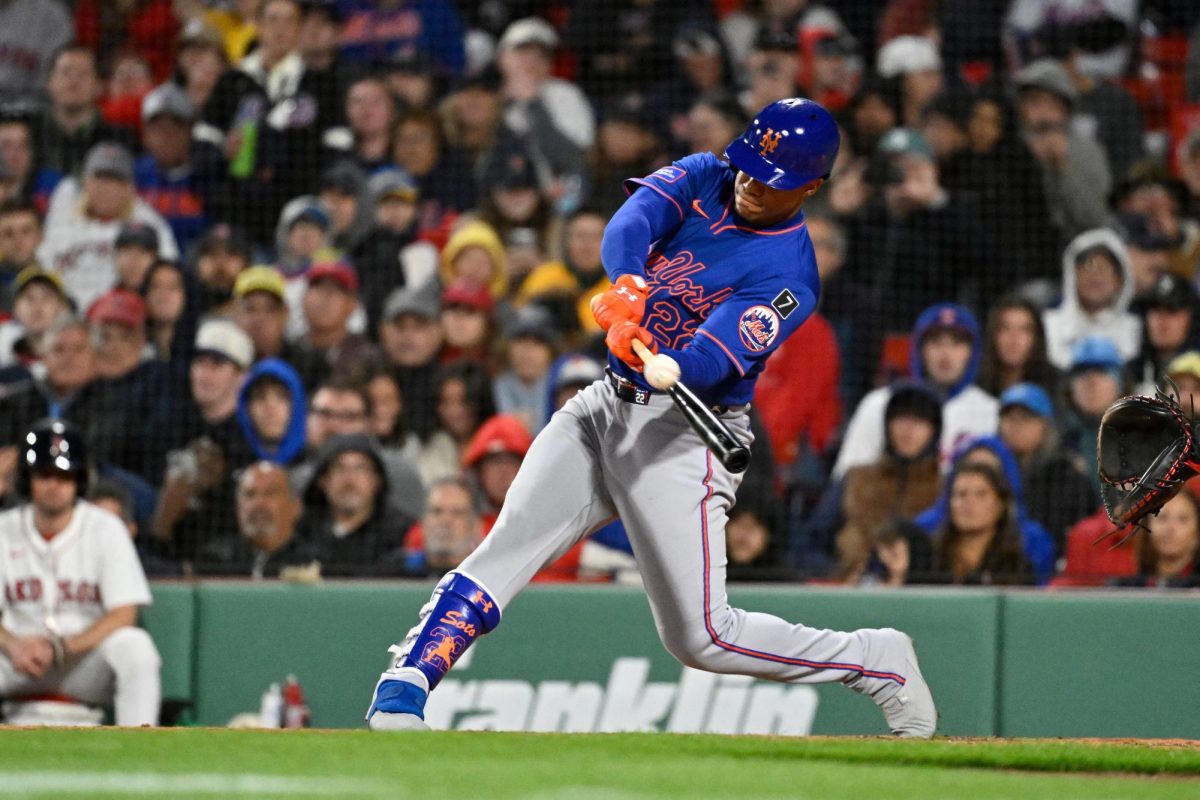
This group of position players was as talented as any other group of players in baseball but was one of the most frustrating offenses I’ve ever seen. If at the beginning of 2025, someone told a Mets fan about the seasons the “core four” of Juan Soto, Pete Alonso, Francisco Lindor and Brandon Nimmo each had, it would have all but guaranteed a playoff berth in their eyes. Soto led baseball in walks, again, with 127, and had a slash line of .263/.396/.525, with a career high of 43 homers, and he figures to finish top five in NL MVP voting once again. Soto was consistently setting the table for Alonso, who had his best season since his record-setting 2019 season. Alonso finished 2025 with 126 RBIs, 41 doubles, 38 homers and a slash line of .272/.347/.524. Nimmo hit a career-high in homers, with 25, and Lindor once again had a 30/30 season. It’s hard to complain about the productivity of those four players, and usually the problem wasn’t stemming from them.
The rest of the offense was plagued by a combination of both misfortunes and just mediocre performance. While some players made huge jumps forward in terms of performance, such as; Brett Baty, who may have saved his Mets career with the solid 3.1 WAR season he had; Starling Marte, who may have saved his career with a .745 OPS in his age 36 season and Francisco Alvarez, who continued his stellar defense behind the plate and had the highest OPS of his career at .787, many struggled deeply throughout the season. Even with big bats like Soto, Lindor, Alonso and Nimmo in the lineup, it’s impossible to win anything without the necessary role players surrounding them, and Baty, Marte and Alvarez were not enough. Each struggled with inconsistency despite their good individual seasons, and each had at least one stint on the injured list during 2025.
As for the rest of the hitters, things were bleak. Mark Vientos, who came off 2024 with a .837 OPS, 27 homers and a 3.1 WAR, earned the starting third base job out of spring training, only to struggle to a .702 OPS, 17 homers and a -0.2 WAR. It was a disappointing season for a player who ranked as one of the best third basemen in the National League in 2024 and who projected to become a core Met in the not-so-distant future of the organization. Along with that, the Mets big offensive trade deadline acquisition, Cedric Mullins, posted a mere .565 OPS as a Met. Tyrone Taylor, Luisangel Acũna and Ronny Mauricio each had disastrous offensive seasons.
It’s also worth noting that the Mets had an extreme stroke of bad luck in 2025. They were second in the league in hard hit %, xWOBA, xSLG, xAVG and average exit velocity and third in barrel %. The Mets finished middle of the pack in AVG, OBP and SLG. Essentially, the Mets were hitting the ball hard, but either right at fielders, or they were leaving many, many runners on base. This was also a major part of their downfall.
Adding onto the downfall, the bullpen went through a period where it seemed like there was a higher chance of winning the lottery than watching the Mets bullpen close a game. Beyond Edwin Diaz, who is on pace to win his second Reliever of the Year award, the bullpen in Queens was as inconsistent as it gets. The Mets had the sixth most blown saves, at 27, and walked 232 batters. The Mets cycled through dozens of relievers throughout the season, all struggling at least one point in the season.
Ryan Helsley was tipping pitches all throughout his time on the Mets, which cost them numerous wins. Tyler Rogers couldn’t pitch effectively unless he had no runners on base. Reed Garrett went through times when he couldn’t throw his splitter more than 58 feet. I could keep going with examples of ineffective pitching. Simply put, there was no one in the Mets bullpen to trust to close a game, besides Diaz. Add that to overworking the bullpen due to starters not pitching deep into games, and you have a perfect recipe for blown game after blown game.
Looking Ahead to This Winter
Based on all the information I gave in the prior section of the article, you are probably thinking a huge shakeup will be coming, and you wouldn’t be too far off, as a lot of players will have the option to depart New York this winter. The Mets have 11 pending free agents, and five with contract options. The Mets pending free agents are Alonso, Marte, Mullins, Helsley, Rogers, Canning, Jesse Winker, Gregory Soto, Ryne Stanek, Richard Lovelady and Chris Devenski. Diaz has a player option that he’s likely to opt-out of, to test the free agent market and try and sign a bigger contract. Montas has a player option, which he is expected to opt into as he rehabs from Tommy John surgery and will miss all of 2026. Reliever AJ Minter also has a player option and is expected to opt in as he spent a substantial portion of 2025 rehabbing from a left lat tear. The Mets only have two club options available, which are on Drew Smith, who was recovering from Tommy John surgery for all of 2025 and is expected to be picked up for 2026, and Brooks Raley, who may have been the most effective Mets reliever aside from Diaz.
Despite all of the potentially departing players, the Mets have a sizable number of players still under contract and eligible for arbitration this winter.
The way I view it, the Mets have a few main questions to answer while building their team for 2026, which are as follows:
– Will Diaz and Alonso play a significant role in the Mets future and is there a scenario in which both can be brought back? If not, who replaces both?
– Where can the Mets find a frontline starter and build depth in their rotation while limiting walks, and giving their prospects, like McLean, Tong and Sproat, a chance to compete in 2026?
– How can the Mets optimize their deep farm system? Will top prospects get a chance? Or will some be moved as trade pieces?
– What bullpen pieces are reasonable to look for to help minimize blown saves?
– Which departing Mets deserve a chance to resign with the team? Which don’t? Which veterans could be on the move in terms of trades?
– Will Mets Manager Carlos Mendoza be on a short leash with his team in 2026?
My predictions to the questions will follow in part 2 of the Mets Offseason Preview.