












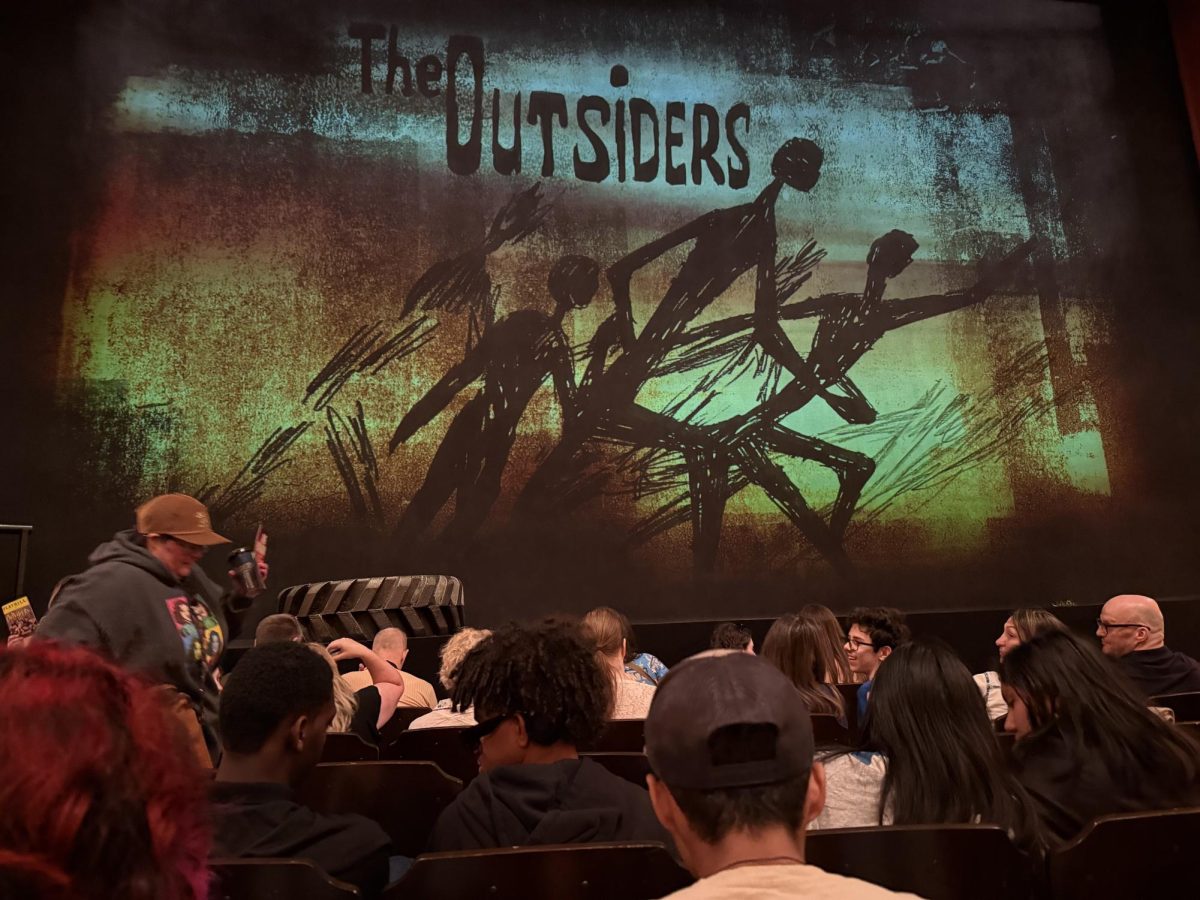
Part one of the musical “The Outsiders” focuses on establishing a wide cast of characters and their relationships with one another. While comparatively slow compared to the second half of the show, it plays an essential role in building our attachment to the setting and people we later see end tragically. “Tulsa 67” and “Grease Got a Hold” depict life as a member of the lower class; it is harsh, mature and often hopeless, hidden by a shared act of toughness and grease. Individual songs provide insight into the character’s emotions, a difficult task for the narrator Ponyboy to tackle otherwise.
A fundamental aspect of the plot is the disparity between the Greasers and the Socs. The Greasers live in the impoverished, crime-ridden regions of Tulsa, while the affluent Socs stick to their McMansions and golf courts. A difference in economic and social standing is made ever more evident in the set design, where the ‘downtown’ side of Tulsa appears covered in grime and sweat as opposed to the shiny, clean environment that the Socs inhabit.
In spite of their different backgrounds, the two cliques occasionally brush elbows in school or at the theater. Here is where attempts are made at providing depth for the aforementioned Socs, whom the viewer has thus far condemned. We discover through the character Cherry that the Socs have problems, too. However, their problems appear laughable when Cherry immediately laments the musical returns to Ponyboy’s domestic life. Peers who had watched the show shared similar beliefs, pointing out the persisting gap in the Greaser-Soc situation. While the Greasers were never particularly likable in the book, there was a stronger justification for their actions that is simply not covered in the musical. Apart from lackluster antagonists, “The Outsiders” still has the Greasers as a source of substance.
With consent from writer S.E. Hilton, the races of certain characters were changed in order to better reflect the demographic of Tulsa in ’67. Historically, Tulsa has seen racial discrimination destroy and perpetuate terror against communities; the Trail of Tears and the 1921 Race Massacre are significant parts of the town’s history, and they certainly bled into the treatment of ethnic minorities in the ’60s. The decision to portray Dally’s character as African American was a difficult, specifically due to the nature of his original death. Regardless, the changes made were met with less backlash than expected, instead receiving high praise for their realism and new perspective.
Part two of “The Outsiders” features a distinct shift in both mood and setting. As the curtain rises, Ponyboy and Johnny are seated in the abandoned church, where dim lighting beautifully underscores the fear and sorrow of their escape. This second half is undoubtedly the most invigorating part of the production, masterfully juggling multiple strings of tension: the boys’ concealment from the police, the shifting dynamics among the three Curtis brothers and the looming presence of death.
Dallas “Dally” Winston, played by SeQuoiia, truly gets his moment to shine here—and he excels beautifully. His featured song, “Little Brother,” perfectly encapsulates the profound grief of losing a loved one. The raw holler at the end of the number wonderfully telegraphs his shattered emotional state leading up to his suicide in front of the train. This marks a key departure from the original book, where Dally dies in a police shootout under the flickering streetlights, and it translates powerfully to the stage.
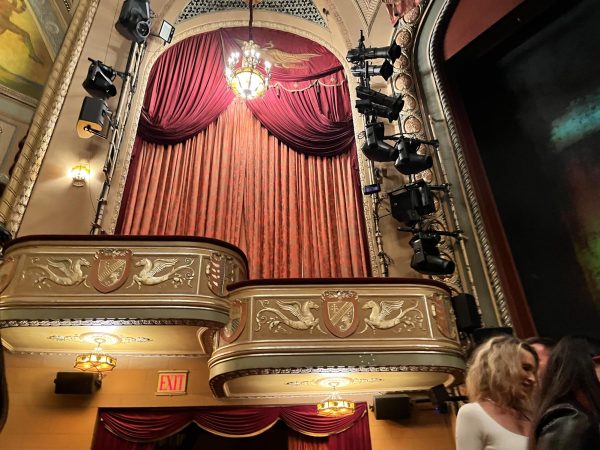
The production also experiments with bold technical effects, though their success is a bit of a mixed bag. The slow-motion sequences, where the characters move in unison to convey their internal turmoil, are an interesting and lovely concept, but the execution occasionally feels clunky. Similarly, the use of practical elements like fire and water yields varied results. During the church fire scene, where Johnny is fatally injured, the theater surprisingly fills with the actual smell of ash and smoke. While my friend and I briefly looked around, eyes fixed on the exit sign twenty feet to our left, there was ultimately no safety issue—just an intense atmosphere.
The climactic rumble, which follows the intense penultimate song “Trouble,” combines both the rain effects and the slow-motion choreography. It is deeply cinematic and thrilling to watch, especially the way the water sprays as the actors strike one another. Audience members, particularly those in the front rows, do get splashed from time to time. While I noticed some people complaining about the wet zone, I felt it successfully immerses viewers right into the world of the story.
The musical concludes back in the Curtis brothers’ home with the reflective “Finale (Tulsa 1967).” While the ending feels somewhat lackluster, it seems as though that is exactly the point. The understated conclusion effectively demonstrates the lingering uncertainty and the sudden, almost eerie mundanity of their new reality—as if everything is normal, and it is simply just another day at the Curtis home.