



















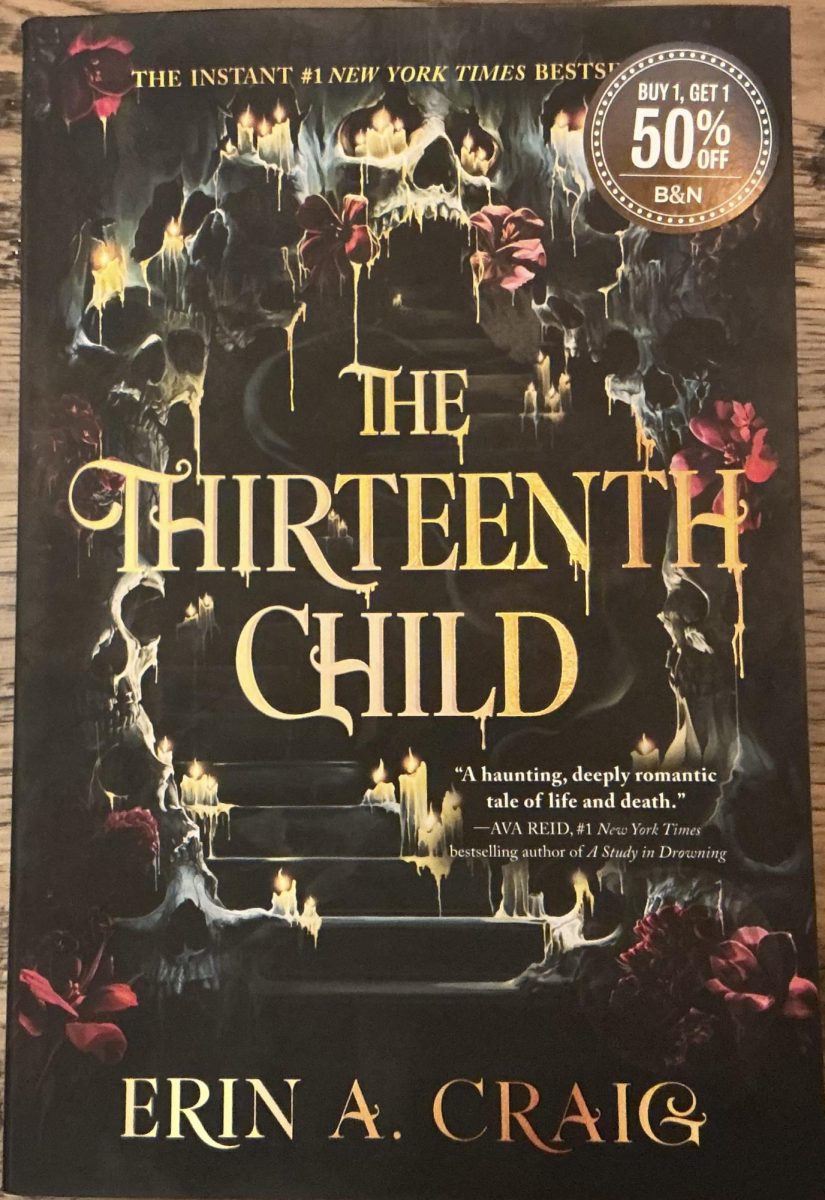
“The Thirteenth Child”, written by Erin A. Craig, is a colossal account of life and death through the eyes of Death’s goddaughter. Like a master quilter, Craig interweaves the past and future, creating a shimmering tapestry of life and death. Spanning decades, we watch the protagonist, Hazel, grow from a neglected, overlooked child into a confident young woman, and finally, an old crone, awaiting death. Throughout Hazel’s journey through life, we become familiar with not only the different aspects of Hazel’s character, but with her surroundings and the vast world in which she lives. Instead of looking through a telescope, with only a magnified snapshot of Hazel’s life visible, “The Thirteenth Child” equates to looking out over an endless horizon from the summit of a mountain. The only limitation on your vision is how far your eyes can see.
Hazel is the final child in a large family already stretched thin. She is the thirteenth child, and upon her birth, her parents decide she is one child too many. When Hazel’s parents consider killing or selling her, three deities come to visit: The Holy First, mother to all, The Divided Ones, harbingers of chaos and bringers of fortune, and The Dreaded End, or death. While each god does their utmost to convince Hazel’s parents she belongs with them, only The Dreaded End succeeds. However, after promising Hazel to The Dreaded End, the god disappears, and not a trace of him is seen for the next 12 years. The premise of The Thirteenth Child is enticingly original. A myriad of possibilities stoke the flames of the reader’s anticipation, creating lofty expectations for the story to come. However, superb beginnings are not unusual in romantasy. What makes “The Thirteenth Child” an utterly amazing novel is where Craig takes it from there, spiriting the reader away on a journey like no other.
The setting of “The Thirteenth Child” is vast and unforgiving. From Alletois, the small, impoverished village where Hazel grew up, to the Between, an inter-dimensional plane only gods can grant access to, the story spans a variety of backdrops as expansive and diverse as Hazel’s journey itself. A grievance I have with a multitude of romantasy novels is the lack of world-building and travel, two of the building blocks of a good adventure. How are we, the readers, to familiarize ourselves with the world in which the story is taking place if we only see a fragment, a fraction of a world supposedly grand and vast? When the beautiful, detailed, ornate maps in the front of books are rendered inconsequential, how can we imagine a story beyond that one region? “The Thirteenth Child” more than satisfied my wanderlust, with a multitude of intriguing settings and diverse plot lines.
From the beginning of Hazel’s life to the end, the world of “The Thirteenth Child” is stretched to the boundaries. The conflict climaxes around The Capital, a viper’s nest of political aspirations and a grotesque demonstration of the carelessness of the wealthy. The Capital has been overrun by a disease aptly named The Shivers, deadlier than any other in history. It is up to Hazel to end it.
Moreover, the characters in “The Thirteenth Child” are multifaceted and compelling. Hazel is, undoubtedly, a flawed main character. However, her flaws are understandable, and over the course of her life, we see her grow as her perspective on her duty as the goddaughter of death change. Hazel is constantly in metamorphosis, always changing and always learning, like an actual human being, giving her form and shape. She becomes more than just words on paper. Hazel’s parents, while cruel and uncaring side characters, are shown to have struggles and regrets of their own. Hazel’s siblings, Kieron, Prince Leopold, Princess Bellatrice and King René, are only a few of the diverse cast of characters “The Thirteenth Child” provides.
“The Thirteenth Child” is a true masterpiece of a book, with enticing characters and vast, expansive world-building. The genre of romantasy is no stranger to formula; in fact, it’s built around it. However, “The Thirteenth Child” has forged a new path for the genre, one I hope becomes an influential source in the world of romantasy and a blueprint for future novels to learn and build from.