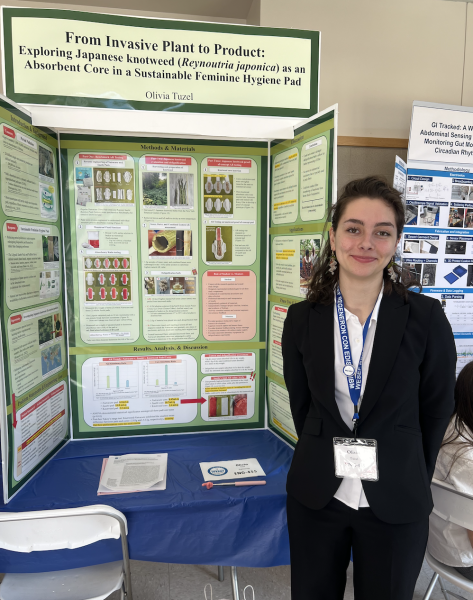

















Olivia Tuzel, a senior at White Plains High School, recently published an article in the journal mdpi.com about how Japanese knotweed, an invasive plant, can be used in a feminine pad as a more absorbent core.
Tuzel said that she only became fully dedicated to focusing her studies on this topic during her junior year, her second year in the White Plains High School Science Research Program. She was originally planning to study the effects of COVID-19 on children’s speech but felt more passionate about feminine care and what she could do to improve it. Tuzel said that she was always curious about the amount of plastic that a feminine pad consumes, and she wanted to shift her studies toward this issue.
Tuzel spent her junior year figuring out what she wanted to study and looking for mentors who could help her. She completed her project and executed everything that needed to be done during her senior year.
Tuzel said that she reached out to almost 100 possible mentors to help with her study and didn’t stop searching even when many didn’t respond. One of the last people that Olivia reached out to, Dr. Skip Rochefort at Oregon State University, became her mentor. “He was a huge help in helping me with my project, but also with instilling confidence.” She also looked into this study over the summer at the University of Utah with Dr. Jeff Bates, another mentor that she reached out to. She also received a lot of help from other mentors on the side who gave her feedback and more information that she could use for her project.
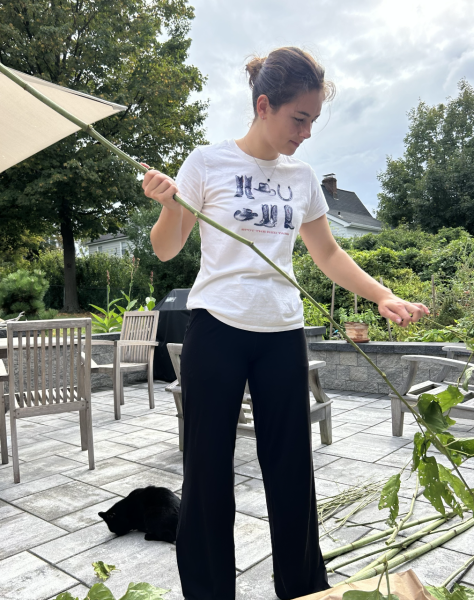
Tuzel worked on her study throughout the summer in order to have it ready by the beginning of her senior year. “I wanted to use an invasive plant that everyone hates so that I could find a better purpose for these plants. I did some research, and I found Japanese knotweed, which was perfect,” Olivia said.
She went to the New York Botanical Garden to access the plant and brought it back home with her to work with, but she also found it in other areas and used it from those spots as well.
“Once I knew what Japanese knotweed looked like, I would see it everywhere, next to people’s houses or even on the side of the highway,” she said.
In November, Tuzel started working on the paper that she hoped to publish and continued working on it until the end of December with help from her mentor along the way. After the publishing company sent her revisions and she resubmitted, her article was approved to be published.
Tuzel said that her article and study being published has opened so many new doors for her. People have reached out to her asking to hear more about her project and wondering if she could get involved in other branches of this topic.
She recently competed at WESEF, which is a Science Fair where Senior’s are able to compete. Olivia got 4th place in the Engineering category, and won $25 in prize money. She will be attending the University of Chicago for college.
Tuzel wants to continue to look into her study in more depth to explore how she could do more to improve the feminine pad even after high school and the WPHS Science Research Program.
Click this link to read Olivia Tuzel’s published article: https://www.mdpi.com/2673-4117/7/2/99